Direct mail is not dead, but it is not a magic postcard either.
I get postcard mailers in my mailbox weekly. It gets picked up with the rest of the stack of mail, carried across the kitchen, and sorted over the recycling bin. In that brief moment of glancing at the card, I make a decision if I am going to accept whatever offer is presented to me on the postcard. Most of the time, I toss it into the bin in less than a second of looking at the card if I am not immediately hooked on the offer.
Whether the company that sent out the mailer believes it or not, the mailer did its job that day. It showed up in my hands in the middle of the mail pile, and forced me to consider (even subconsciously) if I was going to approach the company. Unfortunately, what failed was not just the flyer, but the rest of the marketing system around the flyer. The card did not do enough to capture my attention for more than that half second, there was no easy next step other than calling the phone number listed, and I didn't want to be bothered to look up the company and learn more about them from anything the offer was telling me.
The lesson here is that a mailer is not a campaign. It's one visible touch on a system, and three separate things have to go right for it to pay off. It has to get read in the half second it gets, it has to send the reader somewhere that actually matches the offer for more information, and the business should be able to tell that they were approached beyond my cursory glance. If any of these things are missed, the postage is wasted, no matter how good the printing looks.
Why do most mailers get ignored?
You are not reading a mailer the way the designer hoped. Like me, you are glancing at it over the recycling bin, and that glance is the whole budget for that mailer. A mailer has to land its point in about the time you would have to read a billboard on the highway, which is to say one clear thought, taken in at a glance, while you are mostly thinking about something else.
If you run an attention heatmap over a typical busy mailer, a tool that predicts where the eye is likely to go first, you can watch that budget get spent on nothing. The average attention span is scattered, and when two headlines compete for the top spot, neither wins. A giant promotional date shouts louder than the company name. Photos fill every corner, a list of services runs down one side, and the phone number, the one thing you want a ready buyer to see, sits small at the bottom. With no single focal point, the eye bounces around, finds no place to land, and moves on to the next piece in the stack.
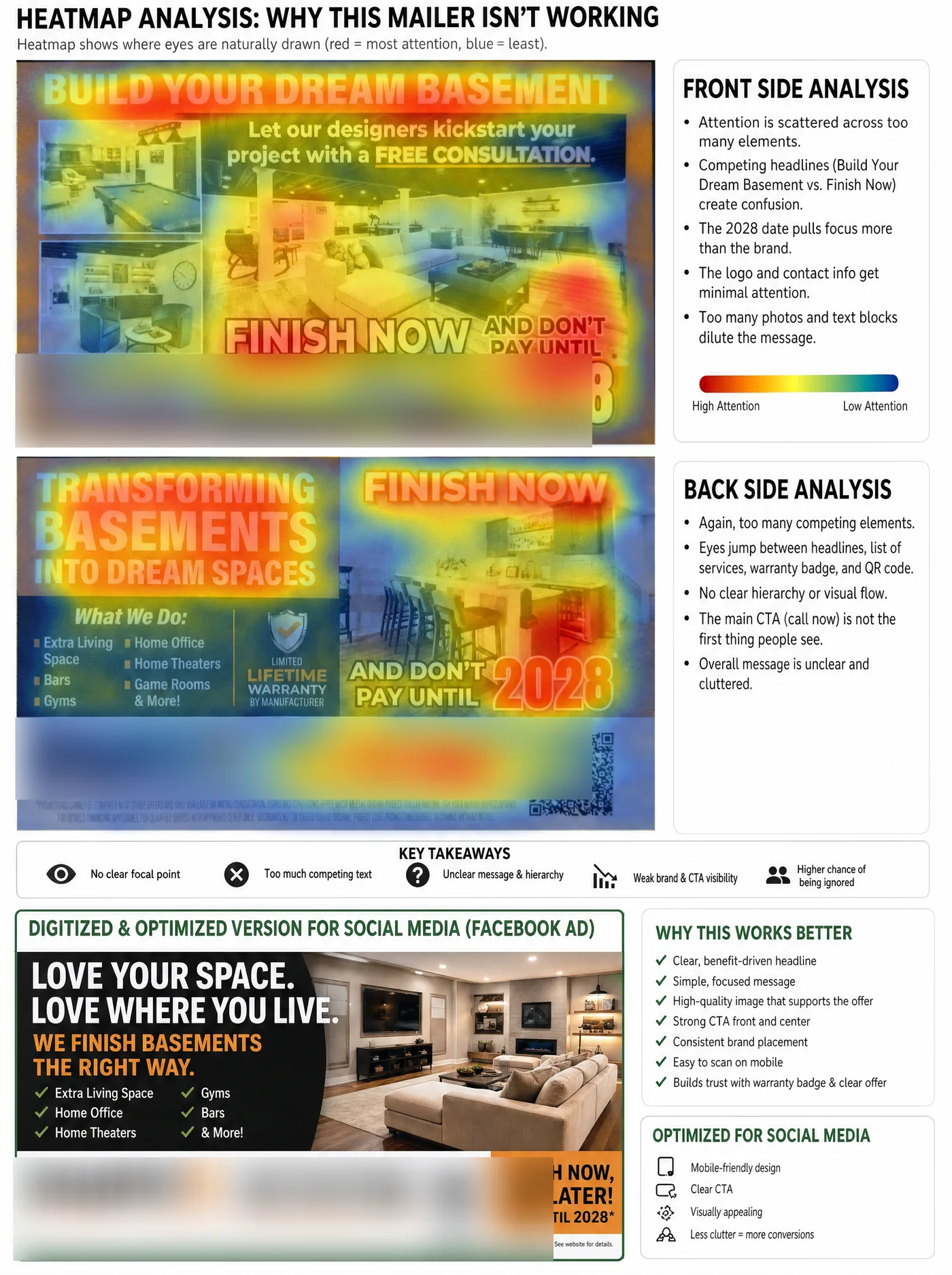
An attention heatmap of a typical busy mailer. The warm areas are where the eye lands first. Notice how it scatters across competing headlines, while the contact details, the one thing a ready buyer needs, get almost none.
Now, this heatmap has some use, but its worth pointing out that it is merely a prediction of attention, not a measurement of real customers. What it does well is make an obvious truth visible; a mailer with five messages communicates none of them.
The fix is not to cram more information into your mailer's design, but instead one clear message with one offer. One action you want the reader to take to approach you. The brand and the phone number or QR code placed where the eye actually goes, not crammed into the leftover space. A good mailer reads like a billboard, not a brochure. When you can tell at a glance who it is from, what they are offering, and what to do next, you have a competitive chance at beating the rest of the mail in the stack for more than half a second of the reader's time.
Where should a direct mail piece send people?
Say you fix the design. The card is sharp, the offer is clear, and a real person is interested enough to act. Now comes the moment everything has been building toward, and you don't want your reader to have any friction at this point.
Where does that person go? On a lot of otherwise good mailers, the QR code and the web address both point at the homepage of the business, but this is a mistake. A homepage is built to answer everyone and give expounding information about the whole business and it distracts from the core purpose of the mailer; one decision on one offer. If I am directed to the homepage, I am experiencing friction and may just leave because I don't want to spend any more time on making this decision. Even worse case is if the QR code points to a broken link, or loads horribly slow on mobile phones. Either way, you spent money to create a spark of interest and then gave it nowhere to go.
The handoff from paper to screen is where direct mail typically falls apart. The fix is a dedicated landing page that matches the mailer word for word. If the card says "Get your free home value estimate," the scan should open a page that says exactly that, with one thing to do and nothing else to wander off into. The promise on the card and the page the customer lands on should feel like the same conversation.
How does direct mail fit into a marketing system?
Let's step back and look at the whole system. The mailer is the part you can hold, but it is only the first step. In a working system the mail brings someone in, a focused landing page captures them, a follow-up email or call keeps the conversation going if the sale isn't immediate. The postcard is the traffic. The system is everything after it.
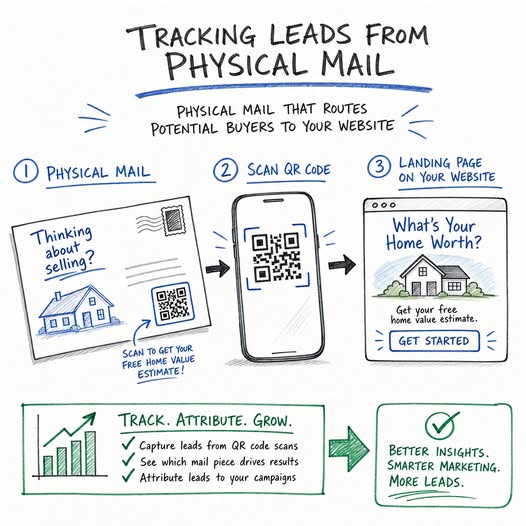
The handoff that makes a mailer measurable. A QR code routes the reader to a landing page built for the offer, so every lead can be captured, attributed to the piece that drove it, and improved on next time.
And you have to be able to see it working. A trackable QR code or a web address unique to that mailing tells you how many people scanned, how many turned into leads, and which mail piece drove them. That is the difference between "we mailed five thousand postcards" and "we know which mailing brought in eleven customers and what each one cost us." When owners say direct mail does not work, what they usually mean is that they could never tell whether it worked, so they could not make the next one better.
This is the reassuring part. You do not need a bigger printing budget to fix this. You need the pieces connected. The postcard you already send can become the front door of a system instead of a flyer that lands in a stack and disappears.
How we think about direct mail at TKBS
We do not sell services. We build systems. To be clear about what that means here, we do not print or mail postcards, and direct mail is not part of our pipeline. What we build is the digital system a mailer should connect into. The landing page that matches the offer, the follow-up that keeps a lead warm, and the tracking that tells you what actually happened. Each piece of our system is built knowing about the others, along with many other pieces (website SEO, email automation, and social media ads) that help you maintain a marketing system that is predictable and repeatable.
We are a Michigan company, and we do this for family-owned small businesses that already have a good offer and only need to see it connected. It is the same reason buying marketing one piece at a time keeps failing. Disconnected pieces cannot compound. A connected one can. And we measure it honestly, in real numbers, instead of handing you an industry average and pretending it is your result.
Common questions about direct mail
Does direct mail still work? It works in one specific situation. The ANA/DMA Response Rate Report puts direct mail at a 5 to 9 percent response rate, but that figure is for a house list, the customers who already know you. The number is really measuring that relationship, not the postcard. Send the same piece cold to people who have never heard of you and the math gets much harder, which is why cold mail is rarely the place to start. Direct mail earns its cost when it goes to people who already trust you and lands them in a system that captures and tracks them. On its own, to strangers, it usually does not.
Should a mailer send people to my homepage? No. Send them to a dedicated landing page that matches the offer on the card. A homepage makes an interested person hunt for what they came for, and many will not bother.
How do I track leads from a postcard? Use a QR code or a web address unique to that mailing, and a tracked phone number if you take calls. A tracked web address like this is called a UTM parameter. Those tell you which piece of mail drove each scan, lead, and sale, so you can tell what worked instead of guessing.
What makes a mailer get ignored? Too many competing elements and no clear focal point. When several headlines, photos, and offers fight for attention, the eye finds nowhere to land and moves on. One message, one offer, one action holds attention better than many at once.
What is a good response rate for direct mail? Industry averages exist, but they have no bearing on your specific campaign. The only response rate that matters is your own, measured against your list, your offer, and your follow-up. Without a tracked landing page and a unique scan path, you have no way to know your number, which means you have no way to improve it.
See where your mail is leaking
If you have sent ads in the mail before and they never seemed to pay off, the postcard is probably not the problem. The connections around it are. We will look at the whole path a mailer takes, from the landing page to the follow-up to the tracking, and show you where the leads are leaking out, then build the digital system that closes the gaps.