You have felt this even if you have never run a marketing campaign. You see a beautiful ad for a product. The photography is sharp, the offer is good, and you are interested enough to click. Then the link drops you onto a landing page that is broken, or half-loaded, or clearly built by someone who never saw the ad. Or the page is fine, but you go looking for the real business behind it and the website is years out of date, with no obvious way to contact anyone.
What happens in your head in that moment? You start to distrust the product itself. If the online experience is not seamless and cohesive, you quietly assume the thing being sold is not either. The ad did its job, but everything after it undid that job.
That is what marketing looks like when it is bought one piece at a time. It's worth saying that most businesses end up here through reasonable, one-decision-at-a-time choices, not through laziness. Whether it's a logo from a designer this year, an ad from someone on a freelancer site the next, or a website from a cousin who knows WordPress, each piece is bought on its own from someone who never communicated with the other creators.
The alternative is a marketing system: a set of pieces designed to connect before any of them are built, so that one ad, one landing page, and one follow-up work as a single journey instead of three strangers. That is the difference between buying marketing and building it.
A car is not a pile of good parts
Think about it the way you would think about a car. If you bought an engine from one shop, a transmission from another, and the wiring from a third, and bolted them together in the driveway, you would have something that looks like a car, but it would not drive like one. A car is not a pile of good parts. It is good parts engineered to work together. Marketing is the same, but few business owners treat it this way.
Every piece you buy gets built to its own spec by someone responsible only for that piece. The ad person makes a great ad. The web person makes a pretty site. The email person writes a clever email. Each of them can hand you something genuinely good and walk away having done their job. Nobody in that arrangement is responsible for the handoffs between the pieces, and the handoffs are a critical part of what your customer experiences.
A customer does not experience your ad and your website and your follow-up as separate items on an invoice. They experience one journey, and they feel every moment where it jerks or stalls.
I learned this in a setting that has nothing to do with marketing, which is probably why it stuck. Before starting this company, I wrote software for electric vehicles. I worked on systems engineering for the high-voltage energy systems, the software behind battery performance, charging, energy load, and the communication between all of it. My job was to write the requirements that made the whole system function. We had brilliant engineers writing test cases for individual parts, and a part could pass its own test perfectly. But you could not build the vehicle or test it in simulations on good parts alone. The car only performed when the requirements and the integration between the parts were correct.
A battery test and a charging system test still will not move the car if they were never built to talk to each other. That is the same failure I see in small-business marketing. Every piece might be fine on its own, but the business still does not run.
The two options that both let you down
When an owner realizes the pieces are not adding up, they usually weigh two options:
The first is the big agency. If you have unlimited funds and you are willing to pay an exorbitant fee just to get off the ground, an agency can hand you an entire marketing department's worth of staff. The catch is that a lot of what they sell you is overkill, and if you are not perceptive about what you are actually buying, some of it edges toward snake oil. It is very easy to get lost in the jargon and pay for sophistication you will never use.
The second is the parts guy, the single freelancer who does one thing really well. They might make you a wonderful product reel for social media, or write you a handful of great emails, but the problem is that it is not repeatable inside your business. You get a brilliant piece, once, and then you are right back where you started. What you actually need is a system that takes pieces that are good and makes them repeatable.
What it looks like wired correctly
So what does it look like when marketing is engineered as one thing instead of assembled from many?
When the system is built correctly, everything starts to flow. The ad is written to set up the landing page. The landing page is built to capture the lead the ad just promised. The captured lead drops into an email service that actually holds the relationship. An automated nurture sequence builds trust over the following days instead of hoping the customer remembers you on their own. And a clear call to action turns that warmed-up lead into a customer. Each step exists to hand off cleanly to the next one.
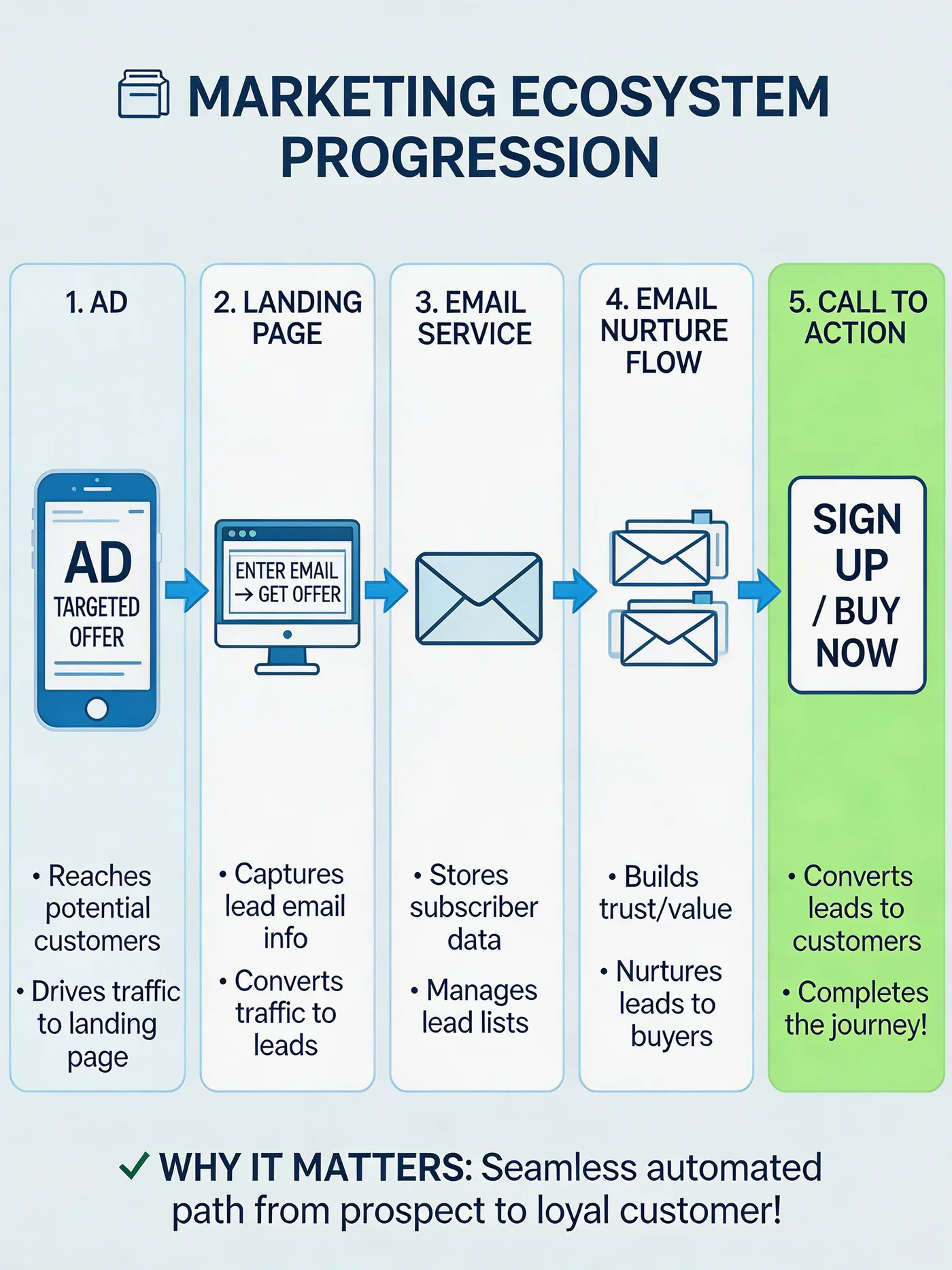
Reach the right person, capture them, nurture them, and convert them, with no broken seam along the way. The customer never feels the handoffs, because the handoffs were the thing we designed first. They just feel a business that has its act together, which is exactly the impression that makes someone trust you enough to buy.
How we think about it
This is why we describe what we do the way we do. We don't sell services. We build systems.
It is not a slogan we reverse-engineered for a website. It is how we were trained to think. In automotive systems engineering you cannot ship a part that has not been validated against the whole vehicle, because a part that breaks the car is not a good part, no matter how well it scored on its own bench test. We build marketing the same way.
That also shapes how we work as a company. We would rather be a long-term partner than a vendor who sells you a deliverable and disappears. We take on a limited number of clients on purpose, and we do not trade in vanity metrics or invented numbers. If something is working, we will show you the real figures and why the system we are building is tying your marketing into one cohesive system.
Frequently asked questions
Why does piecemeal marketing fail even when every piece is good? Because no one in a piecemeal arrangement is responsible for the handoffs between the pieces. The ad person delivers a great ad and the web person delivers a solid site, but if those pieces were never built to connect, your customer feels every broken seam along the way. The broken seams are where you lose them.
What is a marketing system for a small business? A marketing system is a set of connected pieces, an ad, a landing page, an email capture, a nurture sequence, and a call to action, designed to hand off cleanly from one to the next. Traffic becomes a lead, a lead gets nurtured, and a nurtured lead converts, automatically and repeatably, instead of one piece at a time.
What does it mean to build a marketing system instead of buying services? A service is a single deliverable, like one ad or one website. A system is those pieces designed to connect, so that traffic becomes a captured lead, a captured lead gets nurtured, and a nurtured lead converts, automatically and repeatably. You are buying the handoffs, not just the parts.
Isn't one freelancer cheaper than building a whole system? For a single piece, yes. But a great piece that does not repeat inside your business is a cost you pay again and again. A system is built so that good work keeps producing without you re-buying it from scratch every time.
Do I have to throw out everything I already have? Usually not. If you already have a strong logo, a decent site, or an ad that performs, those can often become parts of the system. The work is connecting what is worth keeping and replacing only what breaks the journey.
How do I know which pieces are letting me down? Walk your own funnel the way a customer would. Click your own ad, fill out your own form, and wait for your own follow-up. The first place it feels broken or silent is the seam that is costing you customers.
See where your system breaks
Most small businesses are not losing customers because their product is worse. They are losing them at the seams between pieces that were never built to connect. The good news is that those seams are findable, and fixable, once you look at the whole vehicle instead of the parts.