You spent money or effort to earn someone's attention. Maybe it was a Facebook ad you paid for by the click. Maybe it was a cold email you wrote by hand, or a newsletter you sent to a list you spent years building. Either way, somebody got interested enough to click. The expensive part is done.
Then they land on your homepage, because there is no landing page built to catch them.
Your homepage is built to do a dozen things for a dozen kinds of visitor. It introduces the company, lists every service, links to your blog, your about page, your hours, your social profiles. It is a lobby with ten hallways.
For the one person who just clicked because they wanted help with a specific thing, that lobby is a place to get lost. Most of them do. They look around, see no obvious next step that matches why they came, and leave. You paid for the click, and the click went nowhere.
This is one of the most common and most expensive leaks in small business marketing, but it has a simple fix. You need a landing page.
What is a landing page? A landing page is a single page built to turn one visitor into one lead. It drops the navigation, matches the exact offer that earned the click, and asks for one action. On its own it is still just a page. Connected to your ads, your email, and your tracking, it becomes the piece that turns attention into customers.
| Your homepage | A landing page | |
|---|---|---|
| Purpose | Introduces the whole business | Converts one offer |
| Navigation | Full menu, many paths | Stripped down to one path |
| Visitor | Anyone, arriving for any reason | Someone who clicked a specific promise |
| Next step | A dozen possibilities | One action |
How does a landing page fit into your marketing system?
A landing page is not a standalone asset you build once and admire. It is the convergence point of everything else you do.
Picture it from the customer's side. Every channel you run is a different road into your business. Your ads are one road. Your email list is another. All these roads are trying to get one person to the same place, a landing page where they can take the next step with you. If the roads are good but the destination is a confusing lobby, the whole trip was wasted.
That is why a good landing page has to do three things:
-
Continue the promise that earned the click. Message match means the page a visitor lands on continues the exact promise that earned the click, instead of making them start over. If your ad said "more booked leads from social media," the page they land on cannot open with "Welcome to our website." It has to pick up the exact thought they had when they clicked and keep going. They already told you why they are here.
-
Offer one thing and ask for one action. A landing page has a single job, which is to turn an interested visitor into a lead, and every element on it should serve that job or come off the page. Cut anything that gives the visitor a reason to click away from the call to action.
-
Capture and track. The form has to feed directly into your email system so the lead does not sit forgotten in an inbox. And the page has to be tied back to the channel that sent the visitor, so at the end of the month you can actually see which ad, which email, which road produced real customers. Without that, you are guessing where to spend next.
A landing page without the system around it is a beautiful dead end. The system without a landing page leaks at the most expensive possible moment, right after you paid for the click. You want both, working together.
What does a good landing page look like?
You have landed on a great landing page before, even if you never called it that. Picture the page Netflix shows someone who is not signed in. There is no menu to get lost in. There is one promise, one plan, and one button, repeated.
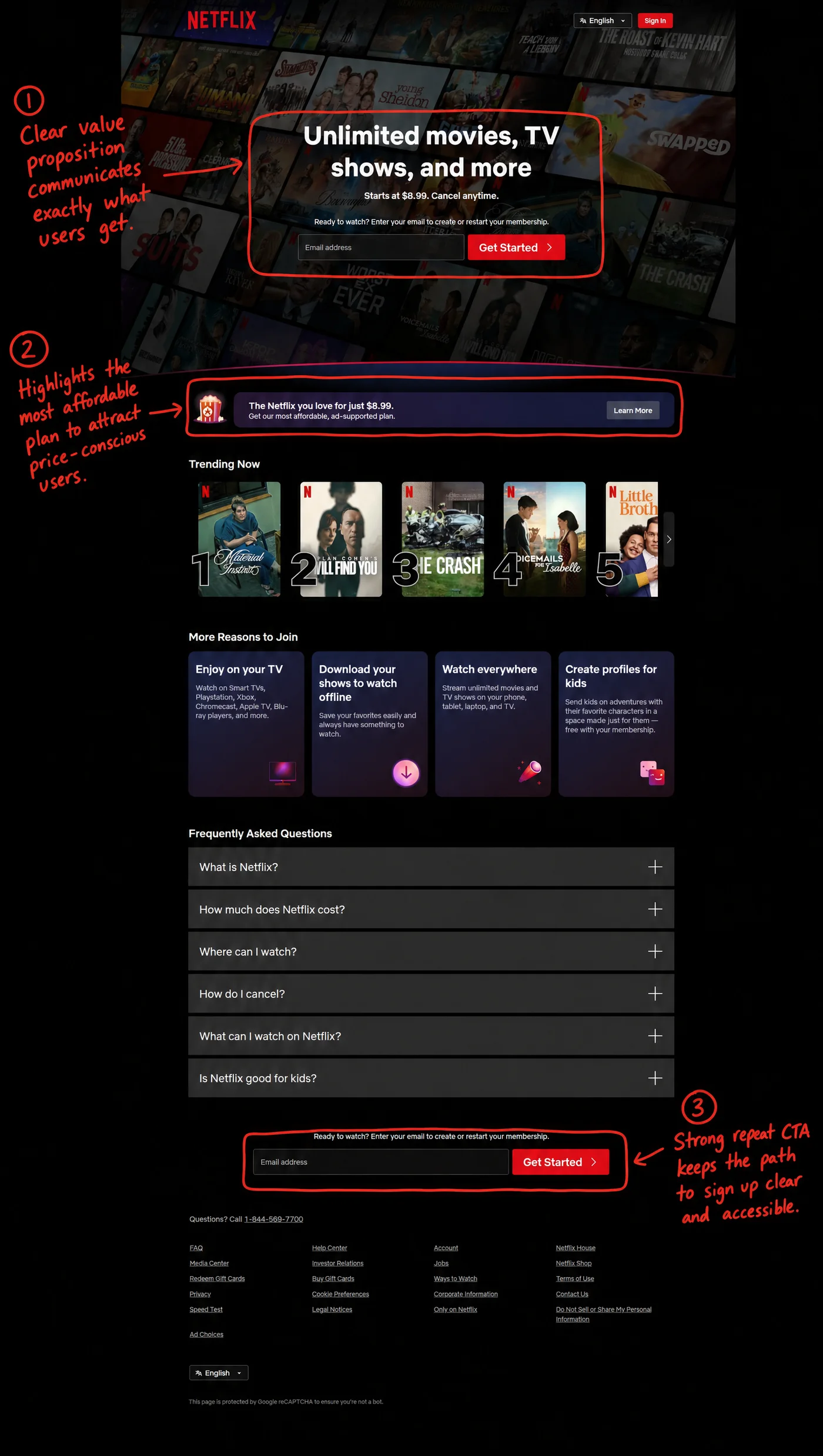
A quick teardown of Netflix's sign-up page. The hero says exactly what you get, the most affordable plan is pushed to the front, and the same email and Get Started action repeats at the bottom so the next step is always one glance away. Annotations courtesy of TKBS.
Notice what it does not do. It does not open with company history, and it does not hand you a navigation bar full of detours. It picks one message, makes one offer, and asks for one action, more than once. That is the entire job of a landing page, on a brand you already trust.
What does this look like for a real business?
TKBS is a two-person marketing and web agency in the Detroit area, and we build complete, connected marketing systems for family-owned small businesses. So we will show you one we built for ourselves, because we would rather point at a real page than describe a hypothetical one.
When we send a cold email to a service business, the call to action in that email does not drop the reader on our homepage. It sends them to a single page built for exactly that conversation: our service company ads landing page, the same page we built to receive paid social traffic. We eat our own cooking here.
Walk through how it fits the system. The first headline the page shows continues the promise: "More booked leads from social, without managing it yourself." It leads with the outcome the reader wants, not with our name. A little further down, the page says the quiet part out loud: "You don't have an ad problem. You have a system problem." It is the whole reason we exist, on the page, in front of the exact person we just earned the attention of. We do not sell services. We build systems.
From there, the page does one thing. It strips out the website navigation entirely, because we do not want this visitor wandering off to read our about page. It funnels everything toward one action: book a free fifteen minute call. The trust we show is the honest kind. You own your ad account. You get clear monthly reporting. No contract. A free ad account audit. We are not going to quote you a conversion rate on this page, because the honest answer is that the right number depends on your offer and your traffic, and anyone who promises you a magic figure is guessing. What we will tell you is that every lead gets tied back to the channel that produced it, and you see those numbers every month.
That is the difference between a landing page that is just a nice design and a landing page that is a working part of a system.
How does TKBS build a landing page?
When we build a landing page, we build the whole thing. The design, the copy, the development, and the part most people skip, which is the integration into your email platform and your ad campaigns. You get a working page wired into your system, not a mockup you have to figure out how to connect. You own your accounts and your data. We tie each lead back to its source and report it monthly, so you can see which part of your marketing is actually paying for itself.
And we will never invent a number or promise you a ranking nobody controls. If something cannot be measured honestly yet, we tell you that instead of dressing it up. Our landing page work is backed by the same 30-Day Lead Guarantee as the rest of what we build.
If you are already running ads, sending cold emails, or have a mailing list, you have already done the hard and expensive part. Let TKBS help you build your best landing page.
Frequently asked questions
Do I need a landing page if I'm already running ads?
Yes. If you are paying for clicks, sending cold email, or working a mailing list, you have already done the expensive part of earning attention. Sending that traffic to a homepage full of navigation wastes it. A landing page focused on the offer that earned the click is what turns that attention into a lead.
What is a landing page, and how is it different from my homepage?
A landing page has one job, which is to turn a visitor into a lead. It removes the navigation, focuses on a single offer, and drives one clear action. Your homepage serves many purposes for many kinds of visitor. A landing page serves one purpose for one kind of visitor, the one who just clicked.
Why can't I just send my ads to my homepage?
Because your homepage answers everyone and converts no one. A visitor who clicked a specific ad arrives with a specific intent, and a homepage full of navigation and competing messages buries that intent under choices. A focused page that matches the ad keeps the momentum the ad created.
Where should I send traffic from a cold email or a newsletter?
To a landing page built around the offer in that message, not your homepage. The page should continue the exact promise the email made and give the reader one clear next step. The closer the page matches the message that sent them, the more of them take that step.
Do I need a different landing page for each campaign?
Often, yes. The strength of a landing page is message match, and a page that tries to match three different offers matches none of them well. A page per offer, or per campaign, almost always converts better than one page asked to do everything.
How do you know if a landing page is working?
You tie every lead the page produces back to the channel that sent it, then watch the cost per lead over time. That requires the page to be tracked and connected to your email system from the start. We report those numbers monthly, and we are honest about what cannot be measured.
See where your traffic lands today
If you are paying for clicks or working hard to earn them, it is worth knowing exactly where those people land and whether that page is built to convert them. We will look at where your ads, emails, and outreach point right now, and show you what a page built for the job would do instead.